

-

Reconnect with friends and colleagues from around the world at the 82nd Scientific Sessions in New Orleans
The Scientific Sessions offer five days of prime networking opportunities for attendees through official events such as the ADA Networking Reception, dedicated session breaks, and informal interactions in the Poster and Exhibit Halls.
-

Register by April 21 to take advantage of Advance Registration rates
Full meeting registration for the 82nd Scientific Sessions includes in-person programming in New Orleans on the hottest topics, trials, and trends in diabetes research, prevention, and care, as well as on-demand access to session recordings following the presentations.
-
Scientific Sessions return to the road for five days of cutting-edge basic, translational, and clinical science
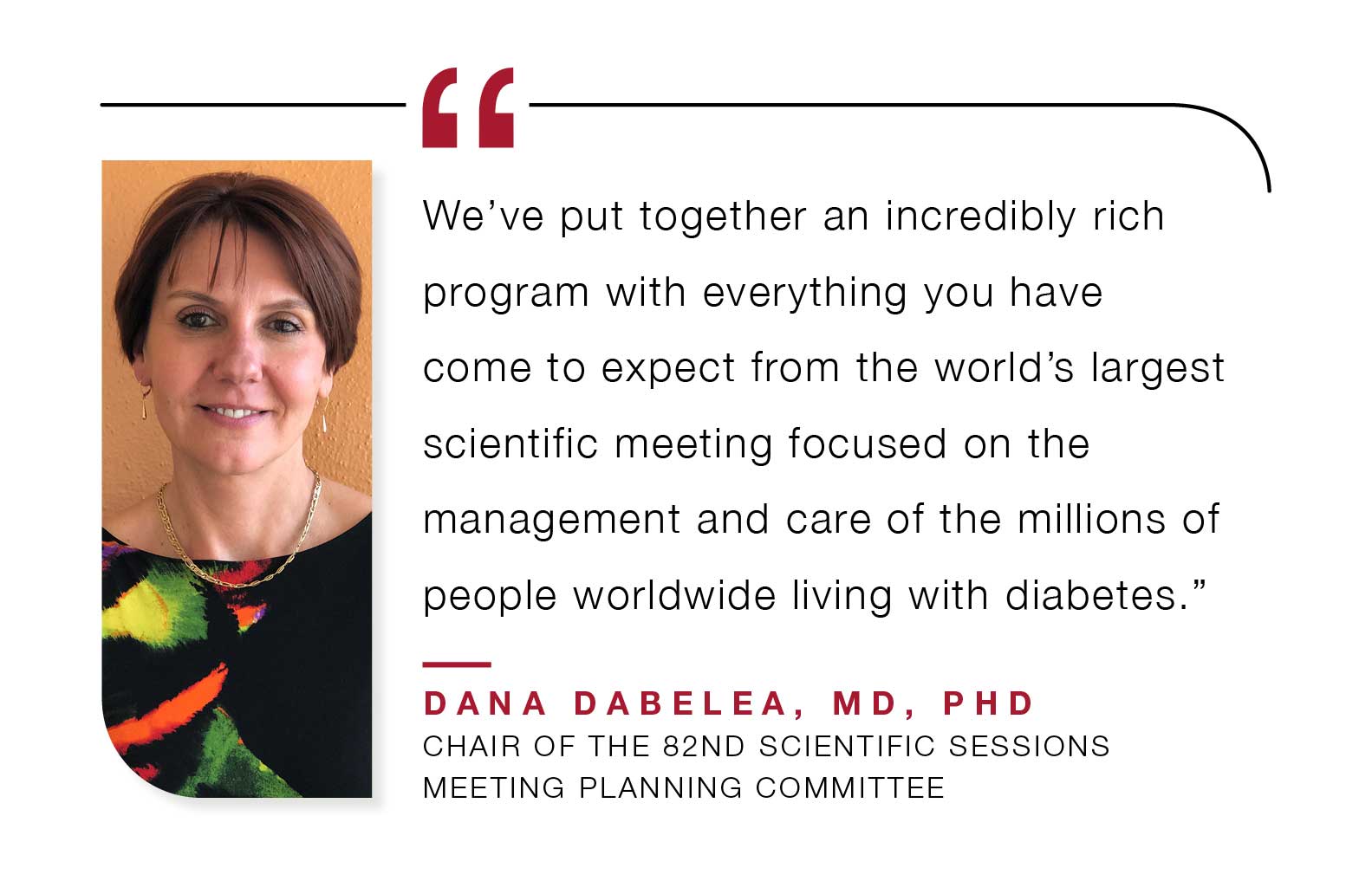
The 82nd Scientific Sessions are headed to New Orleans with a dynamic program featuring more than 180 sessions and over 1,000 original abstract presentations covering the hottest topics, trials, and trends in diabetes research, prevention, and care.
-

Live and in person: 82nd Scientific Sessions headed to New Orleans
The premier meeting in diabetes hits the road for the first time in two years after the COVID-19 pandemic forced the cancellation of in-person gatherings in 2020 and 2021. Virtual attendance is also an option this year.
-
Scientific Sessions COVID-19 policy promotes health, well-being of all onsite meeting participants
Vaccination and facemask protocols are based on guidelines from the U.S. Centers for Disease Control and Prevention and may be updated if CDC recommendations change.
-

Experts debate efficacy of point-of-care A1C for diabetes diagnosis in joint ADA/AACC session
A1C is routinely used to monitor glycemic control for patients with diabetes. At the Scientific Sessions, Jay H. Shubrook, DO, FACOFP, FAAFP, BC-ADM, and David B. Sacks, MB ChB, FACP, FRCPath, debated whether point-of-care A1C should be part of the diagnostic toolkit for diabetes.
-

Researchers using GWAS data to explore genetic risk factors of diabetes
Marcela Brissova, PhD, Struan F.A. Grant, PhD, Maggie Ng, PhD, and Melina Claussnitzer, PhD, discussed how molecular and genetic studies are providing new insight into the influence of genetics in the development and progression of diabetes.
-

Kidney Precision Medicine Project and novel technologies provide new insight into DKD
“The KPMP is all about using the kidney biopsy, which is an old tool, to understand kidney disease in a new way by almost turbocharging the information that we get,” said Jonathan Himmelfarb, MD.
-

Investigators describe single-cell multiomic studies of metabolic tissue function
New research uses single-cell technologies to explore the roles of adipocytes, macrophages, beta cells, and fibroblast growth factor-1 in metabolic tissue function. Qiong (Annabel) Wang, PhD, Christopher K. Glass, MD, PhD, Heiko Lickert, PhD, and Michael W. Schwartz, MD, reviewed this work at the Scientific Sessions.
-

Emerging science refines understanding of how triglycerides impact CVD risk
Brian A. Ference, MD, MPhil, MSc, FACC, FESC, Lisa R. Tannock, MD, Jean-Claude Tardif, CM, MD, FRCPC, FCCS, FACC, FAHA, FESC, FCAHS, and Stephen G. Young, MD, discussed new insights into the role of triglycerides in cardiovascular disease at the Scientific Sessions.