

From continuous glucose monitoring (CGM) devices to autonomous retinopathy screening, artificial intelligence (AI) is embedded in diabetes care. But is it time for an immediate and complete integration of the technology into healthcare delivery?
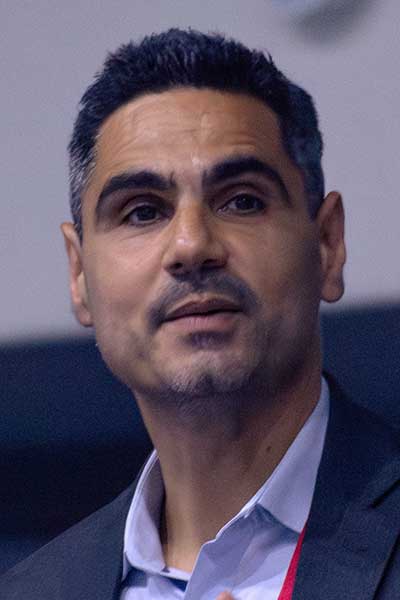
Nestoras Mathioudakis, MD, MHS, presented the affirmative side of this argument, while Neda Laiteerapong, MD, argued against the proposition in a debate format that transitioned into a nuanced conversation about burnout, training, never-skilling, and more at the 2026 Scientific Sessions. On-demand access to this session, Immediate AI Integration into Health Care Delivery: Considering Costs, Quality, and Clinician Burnout, and other recorded presentations, is available to registered participants through August 10.
Drawing on his own experience as a clinician and Professor of Medicine at John Hopkins University School of Medicine, Dr. Mathioudakis argued that it was important to think of AI’s potential in the context of a crisis in diabetes healthcare, with over 40 million Americans living with diabetes, over 115 million Americans living with prediabetes, a looming shortage of endocrinologists, and rampant clinician burnout.
Pointing to a series of studies, Dr. Mathioudakis said that AI could provide needed relief to the system by offering people living with diabetes or prediabetes accessible information and guidance. For healthcare professionals, AI is already providing much-needed support in chart review and summary times, in some studies outperforming human counterparts, and reducing task loads, as well as after-hours documentation demands—all of which are leading to significant reductions in burnout.
Dr. Mathioudakis said that AI allowed healthcare professionals to reclaim distraction-free time with the people in their care, allowing for more engaged and more personal conversations about an individual’s health, goals, and priorities.
“The status quo is not doing enough. We can’t wait,” Dr. Mathioudakis said. “AI can help expand access by bringing specialist-level care to underserved patients, can reduce the clinician burden with ambient scribe and chart review tools helping to reclaim documentation time, and—most importantly—can restore the humanity. AI in the exam room means I’m able to be more present. More eye contact, less screen time.”
Dr. Laiteerapong, Professor of Medicine at the University of Chicago, agreed that AI is and will continue to be a strong presence in diabetes healthcare.

“AI will transform medicine—that is not in dispute,” she said. “The question is whether immediate, unguarded integration is wise.”
Dr. Laiteerapong cautioned that while studies might show that AI can assess medical conditions at near-human levels, or even outperform humans, its mistakes can be at a different magnitude. Rather than being slightly off-diagnosis and then correcting, AI continues to show a tendency to hallucinate answers, providing entirely inaccurate baseline advice, sometimes citing fabricated sources. She pointed to an example in which a well-known large language model (LLM) falsely asserted that the American College of Gastroenterology recommended a specific course of action, when in fact the organization specifically recommended against it.
Dr. Laiteerapong also presented a study arguing that LLMs can be selectively biased in assessing medical conditions depending on how a case is presented to them.
“Would you be OK if I said we have this clinician who hallucinates, is overconfident, unreliable, and biased?” she asked.
Dr. Laiteerapong raised additional concerns about who owns and controls patient data or healthcare professionals’ search histories on AI platforms. She also pointed to studies focused on de-skilling and never-skilling, the concept that the use of AI can weaken core skills among professionals and de-incentivize medical students from ever developing critical clinical skills.
“I personally think that students can engage with these tools—as long as the output is correct—through repetition and actually start learning more because the guidelines are being surfaced for them and it’s more accessible,” Dr. Mathioudakis replied. “They keep seeing the same information, and eventually they’re going to learn it. That’s a different approach than you’re going to go to a single lecture in your second-year class.”
In an ideal world, Dr. Laiteerapong said, learners and healthcare professionals would use AI responsibly, but that doesn’t always happen in the real world.
“People are people, and they’re struggling with burnout,” she said. “And now we’ve created one of the best crutches out there because it sounds overconfident but doesn’t know what it doesn’t know.”

Save the date
Make plans to join us June 18–21, 2027, for the 2027 Scientific Sessions at the Walter E. Washington Convention Center in Washington, DC. Registration will open in January.